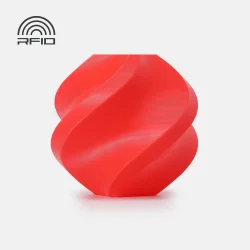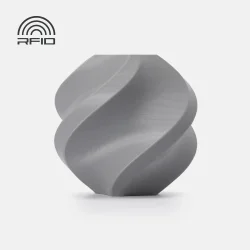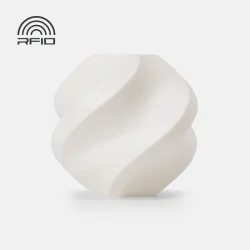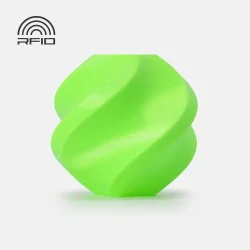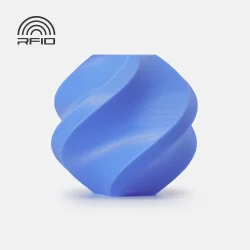
Bambu Lab Filament TPU for AMS 1kg | Yellow
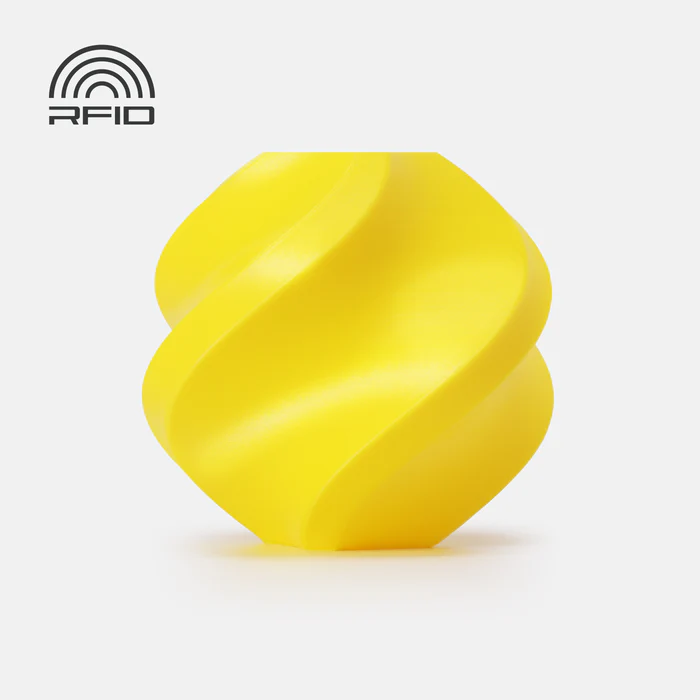
Flexible TPU filament from Bambu Lab optimized for printing in the AMS and AMS lite system with minimal stringing and high print speed.
✔️ Shore hardness 68D - tough yet flexible
✔️ Full compatibility with AMS and AMS lite (RFID chip)
✔️ Up to 60% faster printing than Bambu TPU 95A HF
✔️ Minimal stringing thanks to special formulation
✔️ Nozzle temperature 220-240 °C, speed up to 250 mm/s
✔️ Elongation at break over 650%
✔️ Diameter 1.75 mm ± 0.05 mm, 1 kg spool
✔️ Suitable for covers, cases, stops, and damping parts Show more
Flexible TPU filament from Bambu Lab optimized for printing in the AMS and AMS lite system with minimal stringing and high print speed.
✔️ Shore hardness 68D - tough yet flexible
✔️ Full compatibility with AMS and AMS lite (RFID chip)
✔️ Up to 60% faster printing than Bambu TPU 95A HF
✔️ Minimal stringing thanks to special formulation
✔️ Nozzle temperature 220-240 °C, speed up to 250 mm/s
✔️ Elongation at break over 650%
✔️ Diameter 1.75 mm ± 0.05 mm, 1 kg spool
✔️ Suitable for covers, cases, stops, and damping parts Show more
Product variants
Bambu Lab Filament TPU for AMS 1kg is a flexible thermoplastic polyurethane optimized for seamless printing in the AMS and AMS lite system. It combines the toughness and elasticity of TPU with printing comfort comparable to PLA and significantly suppressed stringing.
Key features
The material reaches a hardness of 68D on the Shore scale, giving it a balanced combination of elasticity, toughness, and impact resistance. Thanks to its special formulation, it minimizes stringing typical of classic flexible filaments and allows printing of clean details even at higher speeds.
Compared to Bambu TPU 95A HF, it offers up to 60% higher print speed and a higher maximum volumetric flow rate (18 mm³/s vs. 12 mm³/s). The RFID chip embedded in the spool enables automatic loading of print parameters by the AMS system without the need for manual setup.
Technical parameters / specifications
| Parameter | Value |
| Filament diameter | 1.75 mm ± 0.05 mm |
| Spool weight | 1 kg |
| Nozzle temperature | 220 - 240 °C |
| Bed temperature (with glue) | 30 - 35 °C |
| Print speed | up to 250 mm/s (up to 238 mm/s in testing) |
| Max. volumetric flow | 18 mm³/s |
| Shore hardness | 68D |
| Density | 1.26 g/cm³ |
| Melting point | 183 °C |
| Tensile strength | 22.4 ± 0.6 MPa |
| Elongation at break | > 650% |
| Drying before printing | 70 °C / 8 h (dryer) or 80-90 °C / 12 h (X1 bed) |
| Recommended storage humidity | < 20% RH (airtight, with desiccant) |
| AMS compatibility | Yes (AMS and AMS lite) |
| Recommended nozzles | Hardened Steel 0.4 / 0.6 / 0.8 mm; Stainless Steel 0.4 mm |
| Recommended build plates | Smooth PEI, Textured PEI |
Who is Bambu Lab Filament TPU for AMS 1kg suitable for
The filament is intended for users who want to print flexible and durable parts in high quality and at high speed, including multi-color printing thanks to full compatibility with the AMS system. It is used in the production of protective covers and cases, phone cases, door stops, sports equipment, automotive components, seals, damping elements, handles, and other parts requiring a combination of elasticity and mechanical resistance. Lower hardness compared to rigid plastics ensures flexibility and the ability to absorb impacts, which distinguishes the material for example from PETG or ABS.
Tips for use
- Always thoroughly dry the filament before printing - moisture is the main cause of stringing and reduced print quality.
- Recommended drying: 70 °C for 8 hours in a convection dryer, or 80-90 °C for 12 hours on the heated bed of the X1 printer.
- During printing, keep the filament in a sealed box with desiccant (humidity below 20% RH).
- The elasticity of the print depends on the number of perimeters (Wall Loops) and infill density - higher values mean a stiffer part, lower values a more flexible one.
- Do not use a 0.2 mm nozzle - it is not compatible with this material.
- For better bed adhesion, we recommend using glue (Bambu Liquid Glue).
- Use hardened steel or stainless steel nozzles for long service life at higher print speeds.
- Make sure the filament feeds into the extruder along a straight path without sharp bends - flexible materials are prone to tangling.
Room 201, Building A, No. 1 First Qianwan Road, Qianhai Shengang Cooperation Zone, Shenzhen
contact@bambulab.com
Hanauer Landstraße 291b, 60314 Frankfurt am Main 60314 Frankfurt am Main Hanauer Landstrasse 291.
contact@bambulab.com