Bambu Lab PA6-CF, 0.5kg | Black

Bambu Lab PA6-CF, 0.5kg | Black

Bambu Lab PA6-CF is a high-performance nylon filament reinforced with carbon fibers, designed for printing strong and heat-resistant technical parts.
✔️ High flexural strength (151 MPa) and stiffness (modulus 5460 MPa)
✔️ Thermal resistance HDT 186 °C at 0.45 MPa
✔️ Excellent resistance to impacts and vibrations
✔️ Nozzle temperature 260 - 290 °C, bed 80 - 100 °C
✔️ Requires enclosed chamber and hardened nozzle
✔️ Drying required before printing 80 °C / 8 - 12 hours
✔️ Ideal for fixtures, holders and machine components
✔️ 0.5 kg spool, diameter 1.75 mm (± 0.03 mm) Show more
Product variants
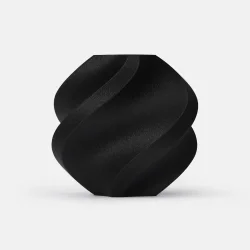
Bambu Lab PA6-CF is a high-performance filament made of nylon 6 reinforced with carbon fibers. It combines exceptional strength, stiffness and thermal resistance with good impact and vibration resistance. It is designed for printing technical and structural parts operated in a dry environment.
Key properties
PA6-CF is a composite filament based on nylon with an addition of carbon fibers. The carbon reinforcement increases flexural strength (151 MPa) and modulus of elasticity (5460 MPa) in the dry state, making the material suitable for stressed structural components. The filament shows high thermal resistance with HDT of 186 °C (at 0.45 MPa load) and a softening point of 212 °C, placing it among materials for technical applications. The material is hygroscopic - it easily absorbs moisture from the air, which affects mechanical properties and necessitates thorough drying before printing.
Printing parameters
| Parameter | Value |
|---|---|
| Filament diameter | 1.75 mm (± 0.03 mm) |
| Nozzle temperature | 260 - 290 °C |
| Bed temperature | 80 - 100 °C (with glue) |
| Print speed | < 100 mm/s |
| Recommended layer height | 0.15 - 0.25 mm |
| Drying before printing | 80 °C for 8 - 12 h |
| Storage humidity | < 20 % RH (sealed, with desiccant) |
| Recommended nozzle | hardened steel 0.4 / 0.6 / 0.8 mm |
| Printer | enclosed chamber |
| Build plate | Smooth PEI, Textured PEI (with glue) |
| Density | 1.09 g/cm³ |
| HDT (0.45 MPa) | 186 °C |
| AMS compatibility | NO |
Who is Bambu Lab PA6-CF, 0.5kg suitable for
The material is designed for advanced users and professionals who print functional technical parts. It finds use in the production of fixtures, clamps, jigs, holders, gears, automotive and machine components as well as structural parts stressed in a dry environment. Thanks to its stiffness and impact resistance, it is suitable for parts exposed to vibrations, impacts and mechanical loads. Printing requires a printer with an enclosed chamber, a heated bed and a hardened nozzle - the abrasive carbon fibers quickly wear out a brass nozzle. The material is not compatible with 0.2 mm nozzles and using a stainless steel nozzle is not recommended.
Printing tips
- Always dry the filament thoroughly before printing (80 °C for 8 - 12 hours) - PA6-CF is extremely sensitive to moisture.
- During printing, keep the spool in a dryer or in a sealed container with desiccant (humidity below 20 % RH).
- Use a hardened nozzle - carbon fibers are highly abrasive and will wear out a standard brass nozzle within tens of hours of printing.
- Print in an enclosed chamber for stable temperature and to minimize warping.
- For better adhesion, apply glue stick to the PEI build plate.
- Remove supports within 2 hours after printing, otherwise they may become stringy from moisture and harder to remove.
- After printing, you can seal the surface of the part with a coating or wax - this will limit moisture absorption.
- When handling the filament and during post-processing (cutting, sanding), wear gloves - carbon fiber fragments can irritate the skin.
- The material becomes tougher after absorbing moisture - for parts requiring high impact resistance, you can intentionally condition them in a humid environment.
Room 201, Building A, No. 1 First Qianwan Road, Qianhai Shengang Cooperation Zone, Shenzhen
contact@bambulab.com
Hanauer Landstraße 291b, 60314 Frankfurt am Main 60314 Frankfurt am Main Hanauer Landstrasse 291.
contact@bambulab.com