
Filament Spectrum PLA Electrically Conductive 1.75mm BLACK 0.75kg
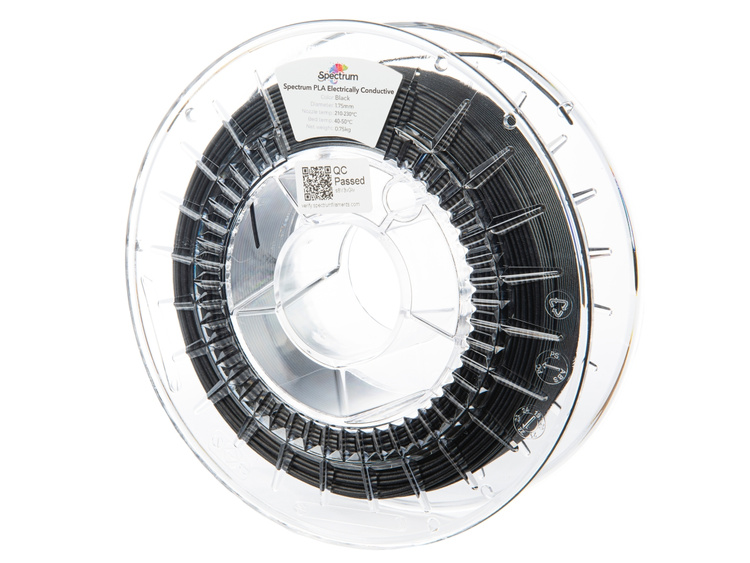
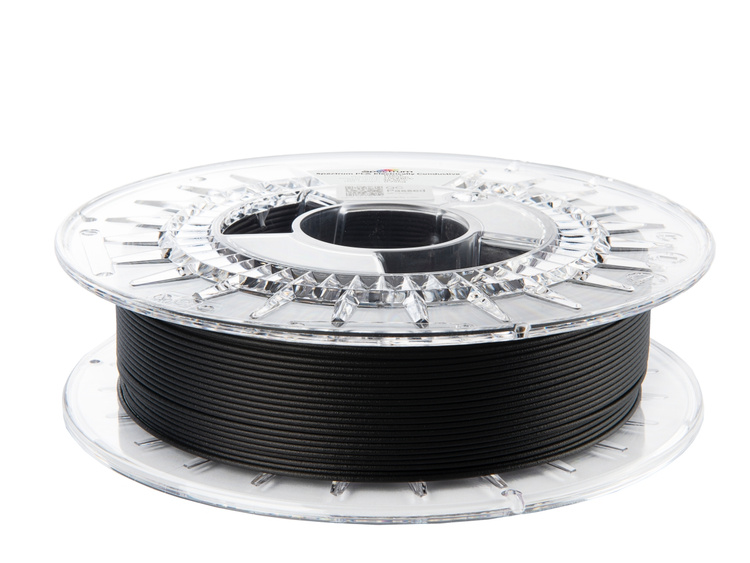


Filament Spectrum PLA Electrically Conductive 1.75mm BLACK 0.75kg

Technical PLA filament from Spectrum with carbon nanotubes, combining easy printing with electrical conductivity and a matte finish.
✔️ Volume resistivity down to ~97 Ω·m at 230 °C
✔️ Easy printing without a heated chamber
✔️ Dimensional stability and low shrinkage
✔️ Matte surface reducing visible layers
✔️ Suitable for antistatic and low-current applications
✔️ Hardened steel or ruby nozzle recommended
✔️ Nozzle temperature 210-230 °C, bed 60-80 °C Show more
Spectrum PLA Electrically Conductive is a specialized technical filament based on PLA enriched with carbon nanotubes (CNT), combining the printing ease of classic PLA with electrical conductivity. It is designed for functional parts that require reduced volume resistivity and antistatic or mildly conductive material behavior.
Key features
The base of the material is PLA polymer modified with carbon nanotubes, which significantly reduce both surface and volume resistivity. The filament retains the main advantages of PLA - low shrinkage, dimensional stability, and trouble-free printing without the need for an enclosed heated chamber. Printed parts have a matte surface that aesthetically softens the transitions between layers. Due to the carbon nanotube content, the material is slightly abrasive, so a hardened steel or ruby nozzle must be used.
- Volume resistivity down to ~97 Ω·m (at 230 °C)
- Electrical conductivity for low-current and antistatic applications
- Dimensional stability and low shrinkage
- Matte surface reducing layer visibility
- No heated chamber required
Printing parameters
| Parameter | Value |
|---|---|
| Nozzle temperature | 210-230 °C |
| Bed temperature | 60-80 °C |
| Print speed | 30-60 mm/s |
| Recommended layer height | 0.1-0.2 mm |
| Filament diameter | 1.75 mm (tolerance ±0.03 mm) |
| Cooling | 30-50 % |
| Recommended nozzle | hardened steel or ruby (min. 0.4 mm) |
| Drying | 45 °C / 6-8 hours (if moist) |
| Enclosed chamber | not required |
According to the manufacturer's measurements, a higher extrusion temperature improves electrical conductivity - at 210 °C the volume resistivity is approximately 120 Ω·m, at 220 °C about 103 Ω·m, and at 230 °C as low as 97 Ω·m. For parts where conductivity is critical, printing at the upper end of the temperature range is recommended.
Who is Spectrum PLA Electrically Conductive filament suitable for
The material is primarily intended for educational environments, workshops, laboratories, and prototype projects where functional electrical conductivity needs to be combined with easy printing. It is used in the production of antistatic covers, simple conductive jumpers, sensor elements, touch buttons, shielding, low-voltage electrodes, educational circuit models, and other parts that require reduced volume resistivity. It is not suitable for high-current applications or for parts exposed to high temperatures - for higher thermal resistance, it is better to choose a filament such as PETG, ABS, or ASA, or composites with carbon fibers.
Printing tips
- Use a hardened steel or ruby nozzle - CNT particles quickly wear out a standard brass nozzle.
- For maximum conductivity, print at around 230 °C with 100% infill.
- If necessary, dry the material before printing at 45 °C for 6-8 hours.
- Store the filament in a dry environment (silica gel, vacuum bags) - PLA is slightly hygroscopic.
- For thin conductive traces, use a lower print speed (30-40 mm/s) for stable extrusion.
- Verify the electrical parameters on a test sample - the resulting resistance depends on geometry, infill, and print orientation.
- Avoid retractions longer than 2 mm to prevent nozzle clogging.