Bambu Lab PET-CF, 0.5kg | Black


Bambu Lab PET-CF, 0.5kg | Black

Bambu Lab PET-CF is a technical composite filament made of PET reinforced with carbon fibers, designed for strong, stiff and heat-resistant functional parts. 0.5 kg spool, 1.75 mm diameter.
✔️ PET matrix reinforced with carbon fibers
✔️ High strength, stiffness and heat resistance
✔️ Low thermal expansion - minimal warping
✔️ Diameter 1.75 mm (± 0.03 mm), 0.5 kg spool
✔️ Nozzle temperature 270 - 290 °C, bed 70 - 80 °C
✔️ Requires a hardened nozzle
✔️ RFID chip - automatic parameter loading in AMS
✔️ Drying required before printing: 80 °C / 8 - 12 h Show more
Product variants
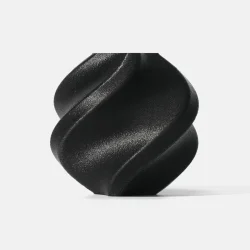
Bambu Lab PET-CF is a high-performance technical filament based on PET reinforced with carbon fiber. It combines the strength, stiffness and thermal resistance of the PET matrix with the excellent mechanical properties of carbon fibers. A 0.5 kg spool with a 1.75 mm filament diameter.
Key features
PET-CF is designed for functional parts that require high mechanical strength, dimensional stability and temperature resistance. Carbon fibers significantly increase stiffness and reduce thermal expansion, which means prints warp less and hold their shape better even at elevated temperatures. The material has a matte surface with a characteristic fiber structure. PET-CF offers better chemical resistance and lower moisture absorption compared to nylon-based materials, yet it is still hygroscopic and must be thoroughly dried before printing. Due to the abrasive nature of carbon fibers, it is necessary to use a hardened nozzle, ideally steel or coated. The filament is compatible with Bambu Lab printers including the AMS system and features an RFID chip for automatic loading of print parameters.
Print parameters
| Parameter | Value |
|---|---|
| Filament diameter | 1.75 mm (± 0.03 mm) |
| Spool weight | 0.5 kg |
| Nozzle temperature | 270 - 290 °C |
| Bed temperature | 70 - 80 °C |
| Print speed | up to 200 mm/s |
| Recommended layer height | 0.15 - 0.25 mm |
| Recommended nozzle | hardened steel (min. 0.4 mm, ideally 0.6 mm) |
| Enclosed chamber | recommended |
| Drying before printing | 80 °C for 8 - 12 hours |
| Storage | airtight packaging with desiccant (< 20 % RH) |
| Density | ~ 1.30 g/cm³ |
| Softening temperature (Vicat) | ~ 85 °C |
Who is Bambu Lab PET-CF, 0.5 kg suitable for
PET-CF is intended for advanced users and professionals who need to print strong and heat-resistant functional parts. It is used in mechanical engineering, robotics, the drone industry, in the production of jigs and fixtures, holders, brackets, structural parts, spare parts for the automotive industry, or for RC models. Thanks to its low thermal expansion, it is also suitable for precise mechanical components. If you are looking for a material for everyday printing of decorations, reach for PLA or PETG instead. For even more demanding applications, you can consider nylon or carbon fiber composites.
Printing tips
- Dry the filament thoroughly before every print - moisture significantly degrades both mechanical properties and surface quality.
- Use only a hardened nozzle - carbon fibers quickly wear out a standard brass nozzle.
- For better interlayer adhesion, print in an enclosed chamber and with a higher nozzle temperature.
- Keep the spool in a dryer or dry box even during printing itself, especially for longer jobs.
- Reducing flow and speed on fine details will improve surface quality and dimensional accuracy.
- For maximum mechanical properties, parts can be annealed after printing - this increases crystallinity and heat resistance.
- Use a nozzle with a diameter of 0.6 mm or larger for smoother extrusion of the composite and reduced risk of clogging.
Room 201, Building A, No. 1 First Qianwan Road, Qianhai Shengang Cooperation Zone, Shenzhen
contact@bambulab.com
Hanauer Landstraße 291b, 60314 Frankfurt am Main 60314 Frankfurt am Main Hanauer Landstrasse 291.
contact@bambulab.com